


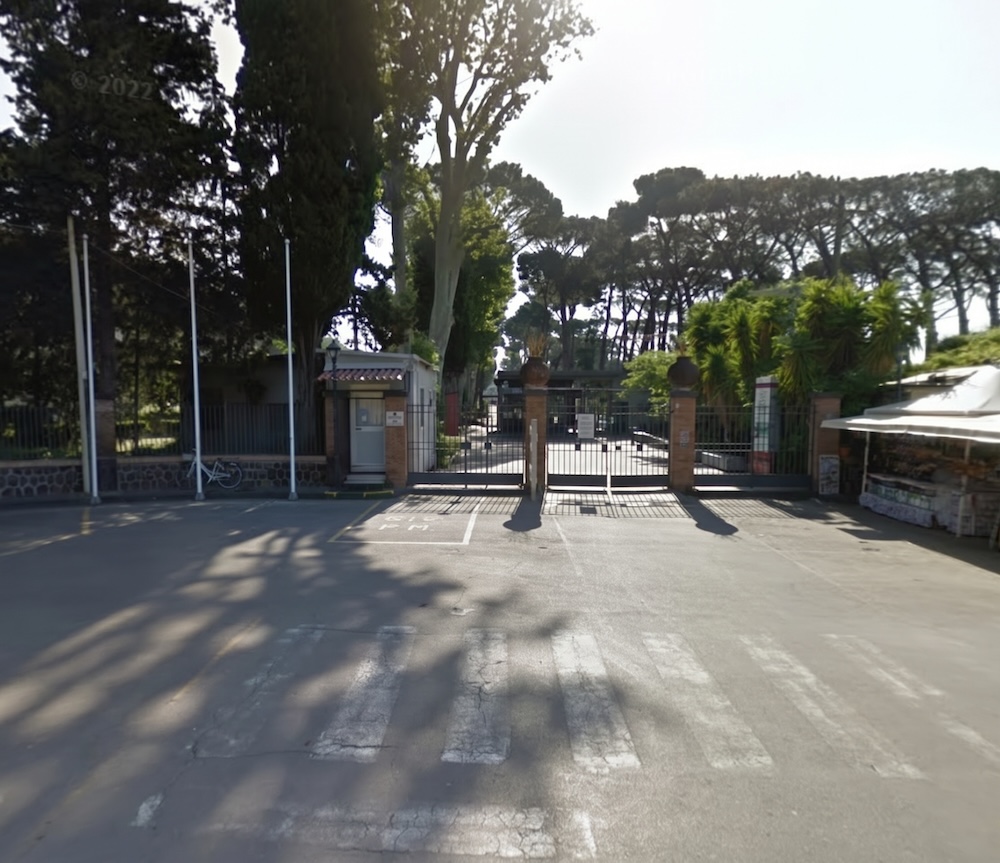



Pompeii stopped mid-sentence nearly two thousand years ago. The Forum still faces Vesuvius. The thermopolia still have their stone counters. Roughly 13,000 people lived here when the volcano buried everything in 79 AD, and today that same city sits waiting beneath your feet. The nearest airport is Naples, around 40 minutes away by train — take the Circumvesuviana from Napoli Piazza Garibaldi to Pompei Scavi, or the faster Campania Express if you'd rather skip the intermediate stops. Either way, you arrive steps from Porta Marina.
What to See in Pompeii
Macellum of Pompeii
The Macellum of Pompeii is the city's ancient public food market, dating to the second century BC and set at the north-east corner of the Forum. A columned courtyard centres on a fish-washing fountain and a tholos, with retail shops lining the perimeter. Frescoes and imperial statues fill the meeting hall inside.
Building of Eumaquia
Commissioned by the priestess Eumaquia, this imposing Forum building served as headquarters for the guild of dyers and fullers. Its magnificent marble Portico of the Concordia Augusta defines the Forum's eastern boundary. The architectural detailing is exceptional, and the building gives real context to Pompeii's commercial and religious world before the eruption.
Quadriportico of the Theatres
Originally a grand promenade with 74 Doric columns where theatre-goers would stroll between performances, this space was repurposed as gladiators' barracks after the earthquake of 62 AD. Excavations uncovered weapons, skeletal remains and military equipment — physical evidence of how dramatically the city's priorities shifted in its final years.
Small Theatre (Odeon) of Pompeii
Built around 80 BC and seating roughly 1,000 to 1,500 spectators, the Odeon was Pompeii's most exclusive venue — a covered theatre used for musical concerts, poetry recitations and philosophical debates. What makes it worth the detour is the acoustics: they remain remarkably effective today, even without an audience.
Water Cistern
Positioned at the city's highest point near Porta del Vesuvio, this Roman hydraulic engineering masterpiece regulated water from the aqueduct through lead sluices into three separate pressure levels — supplying public baths, street fountains and private households simultaneously. It is one of the most precisely preserved pieces of ancient infrastructure anywhere in the Roman world.
Predio of Julia Felix
One of the earliest structures excavated at Pompeii, this substantial private estate occupies half a city block. Built after the 62 AD earthquake, it combines gardens, an atrium, a summer dining room, bathing facilities and rentable commercial spaces. The garden alone makes it one of the most striking spots across the entire Pompeii archaeological site.
Thermopolium of Vetutius Placidus
Located on the Via dell'Abbondanza, this is one of Pompeii's finest surviving Roman fast-food bars. The L-shaped counter still has its embedded storage jars, whilst frescoes of Mercury and Dionysus cover the walls. Excavations found three kilograms of coins inside — a detail that makes the commercial bustle of ancient Pompeii feel genuinely tangible.
House of Venus in a Shell
This Roman townhouse is defined by a single, extraordinary fresco: Venus emerging from a giant seashell on the peristyle wall, flanked by Mars and cherubs. The central garden with its fountain adds to an overall decorative scheme that, even after nearly two millennia, stops visitors in their tracks. One of the most visually arresting private residences on the site.
Audioguide of Pompeii with Guipock
Walking Pompeii without context is a bit like reading a novel with half the pages missing. The Pompeii audio guide on Guipock fills those gaps as you move through the site, giving you the background to understand what you're actually looking at — not just what it looks like now, but what it was.
The audio is produced using high-quality generated audio across a wide range of languages and regional accents — British English, American English, Australian English, European and Latin American Spanish, French, German and more. You choose the language that suits you; each member of your group chooses theirs independently.
Navigation works through a GPS-guided map that tracks your position across the site. When you reach a point of interest, Guipock notifies you so you can open the audio guide for that stop. There's no guesswork about where you are or whether you've missed something significant.
Connectivity inside the archaeological site can be patchy, particularly in the outer areas. The offline download feature removes that problem entirely: download the full guide before you leave your accommodation, and the app runs without any mobile data throughout the day. Straightforward and genuinely useful.
Travelling with family? The family code means a single purchase covers everyone in your group. Each person uses the app on their own device, in their own preferred language, at their own pace. No need to share a phone or wear headphones in turns.
And if you have younger children in tow, the kids' mode adapts the content — shorter stops, accessible language, the kind of details that actually hold a child's attention at an ancient site. It runs as a parallel version of the same visit, so adults and children can explore together without either getting short-changed.
The Pompeii app audio guide is particularly well-suited to a site of this scale and complexity. With more than 150 thermopolia, dozens of temples, private residences and public buildings spread across a large area, having a structured route makes a real difference to how much you take in — and how much you actually remember afterwards.